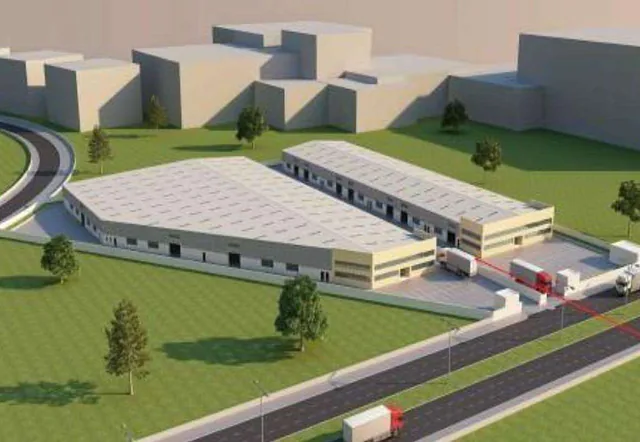
Scope of work
- Assessment of storage type, racking height, commodity class and temperature requirements to define the fire protection and cooling strategy with the consultant.
- High-bay sprinklers, in-rack sprinklers where required, hydrants and fire pumps sized for warehouse hazard levels and the largest design area.
- Ventilation or air conditioning of storage halls, with separate cooling for offices, pick areas and temperature-sensitive zones.
- Cold room and chiller room provisions coordinated with refrigeration specialists, including power supplies, evaporator drainage, panel penetrations and door heater circuits.
- LV distribution for lighting, dock levellers, roller shutters, forklift charging areas with their own ventilation, and general building services.
- High-bay LED lighting with aisle-by-aisle zoning and occupancy controls set so forklift routes stay safely lit while empty aisles dim.
- Rainwater drainage from large roofs with gutters and downpipes sized for short intense storms, plus foul drainage connected to municipal or approved systems.
Systems we install
- High-bay ceiling sprinklers and in-rack sprinkler systems where racking requires them.
- Fire pump sets with electric duty and diesel standby pumps.
- Roof extract fans and filtered make-up air for ambient storage halls.
- Packaged or chilled-water cooling for temperature-controlled storage zones.
- Cold room evaporator drainage with heat-traced lines inside freezer areas.
- LV distribution boards with dedicated forklift charging circuits.
- High-bay LED lighting with occupancy and daylight controls.
Codes, standards and approvals
- UAE Fire & Life Safety Code of Practice for storage occupancies.
- NFPA storage sprinkler criteria referenced by the UAE code.
- Civil Defence approvals in the relevant emirate.
- Utility approvals for power and water connections.
- Free-zone or master developer requirements in logistics zones, such as Trakhees areas around Jebel Ali or DDA-administered zones.
- UAE Fire & Life Safety Code of Practice (UAE FLSC) — national code governing fire-fighting, fire alarm, smoke control and egress
UAE site and climate challenges
- Warehouse roofs in UAE summer radiate heat into storage zones, pushing temperatures high enough to damage some goods. Roof insulation coordination, extract fans and targeted cooling of sensitive zones control temperatures more efficiently than cooling the full volume.
- Dock doors open frequently, letting hot humid air into cooled or cold zones. Air curtains, dock seals and strip curtains reduce infiltration and condensation near doors.
- Cold stores in humid climates suffer ice build-up and condensation at panel joints and door frames. Heated door frames, vapour-tight sealing and controlled anterooms reduce moisture problems.
- Sand and dust enter through roller shutters and coat coils, fans and sprinkler heads. Filtered make-up air, dock seals and planned cleaning access for cooling and fire equipment keep systems working between maintenance visits.
Decisions to make early
- Ambient versus temperature-controlled storage: controlled storage protects pharmaceuticals, food and electronics, but increases energy use, equipment cost and the insulation standard needed for the whole envelope.
- Ceiling-only versus in-rack sprinklers: the choice depends on racking height and commodity class, and in-rack systems add cost, maintenance and the risk of forklift damage to pipework.
- Central versus distributed cooling in multi-tenant warehouses: distributed packaged units suit separate tenants and direct billing, while central plant suits single-operator logistics buildings.
- Lighting control strategy: occupancy sensors and dimming cut energy use substantially in high-bay aisles, but settings must keep forklift routes, docks and emergency paths safely lit at all times.
- Diesel standby versus electric-only fire pumping: diesel standby keeps sprinklers pressurised if utility power fails, but needs fuel management, ventilation for engine heat and weekly test runs throughout the year.
What you receive at handover
- Approved fire protection drawings and hydraulic calculations.
- Pump test and sprinkler test records.
- Electrical test certificates and lighting verification.
- Cooling system commissioning records for controlled zones.
- As-built drawings and O&M manuals.
How we deliver: 8 stages
- 01Appointment & review
- 02Mobilisation & approvals
- 03Planning
- 04Engineering & shop drawings
- 05Procurement & execution
- 06Monitoring & reporting
- 07Quality inspection
- 08Testing, commissioning & handover
Why clients appoint Manolia
Manolia Group has delivered MEP and building contracts in the UAE since 2001: more than 100 projects and over AED 1.1 billion of completed work, including towers above 50 floors. Delivery follows an 8-stage process under a QMS structured to ISO 9001 requirements, with HSE controls and in-house engineering for shop drawings, coordination and commissioning.
Relevant Manolia projects
Cold store (flower plant), DIP
Dubai Investments Park (DIP) · HVAC · Completed
HVAC and refrigeration-environment works for a temperature-controlled facility.
Warehouse, Technopark Dubai
Jebel Ali · MEP · Completed
MEP for a logistics warehouse in the Jebel Ali / Technopark corridor.
Manolya Warehouses, Dubai
Dubai · Building · Completed
G+2 warehouse building.
Frequently asked questions
What fire protection does a warehouse need?
It depends on storage height, commodity type, packaging and building size. Many warehouses need sprinklers, hydrants and fire alarm systems, and high racking may require in-rack sprinklers. The consultant's fire strategy and Civil Defence approval define the exact requirements, which should be fixed before racking is ordered.
Has Manolia worked on warehouses?
Yes. Our warehouse projects include the MEP package for a warehouse in Technopark Dubai and the Manolya Warehouses in Dubai, a G+2 building. We have also carried out design work for tea stores and offices in Jebel Ali and HVAC for packaging and food factories.
Do warehouses need air conditioning?
Not always. Many ambient warehouses use ventilation and roof extract, with air conditioning only for offices, pick areas or sensitive products. Pharmaceuticals, food, cosmetics and electronics often require controlled temperatures, so the decision follows what will be stored and any client or regulator limits.
How do you prevent condensation in cold stores?
By using vapour-tight insulated panels and sealing, heated door frames, anterooms or dock shelters, air curtains and proper drainage from evaporators. Limiting the infiltration of humid outside air is the main factor, so door discipline and fast-acting doors matter as much as equipment.
Can warehouse MEP support future racking changes?
Yes, if fire protection, lighting and power are designed with future storage heights and layouts in mind. Raising racking or changing commodity later may require upgrading sprinklers, revising hydraulic calculations and obtaining new Civil Defence approval, so allowances made early save cost.