VRF / VRV systems in Dubai: local context
Dubai's building stock runs from the 1970s–90s low- and mid-rise blocks of Deira and Bur Dubai to the master-planned tower districts of Business Bay, Dubai Marina and JLT, with villa communities, logistics parks and free zones filling the corridor towards Jebel Ali and Dubai South. Almost every typology is built here at once: residential towers, hotels, clinics, schools, factories, cold stores and staff accommodation. What sets MEP apart in Dubai is the number of approval channels that sit side by side (Dubai Municipality, Trakhees, free-zone authorities and master developers) and the density of district cooling in the newer districts. Manolia has been headquartered here since 2001, so Dubai is where most of its track record sits.
MEP approvals typically start with the master developer or free-zone NOC where one applies, followed by building permit drawings through Dubai Municipality or the relevant zone authority (Trakhees, DDA, DMCC, DSOA, Dubai South). Fire and life safety drawings go to Dubai Civil Defence for approval and later inspection, while DEWA handles load approval, connection and metering; district cooling connections, where available, are agreed separately with the provider. The exact sequence varies by plot and authority, so it is confirmed per project.
- Coastal districts combine high ambient heat with humidity, so equipment selections must be derated for summer design conditions around 46–50°C, fresh air needs real dehumidification, and roof-level condensers and exposed steelwork need corrosion protection.
- Being Dubai-based, Manolia can move labour, materials and testing teams to any site in the emirate within the working day, which matters during tower commissioning and occupied-building works where shutdown windows are short.
Building types we serve in Dubai
For malls and retail centres, the work concentrates on large-volume air handling, tenant-ready chilled water or refrigerant capacity, smoke extraction for atriums and car parks and food-court exhaust.
For palaces and private estates, the work concentrates on discreet high-capacity plant, multi-zone comfort, staff and service blocks, pools and long-term maintenance by an accountable team.
District cooling in Dubai is supplied by providers such as Empower and Emicool, so many projects connect through an energy transfer station rather than building a chiller plant.
Approvals and authorities in Dubai
VRF systems in Dubai sits within Dubai's regulatory framework. The authorities you will meet are:
- Dubai Municipality (DM)
- Dubai Civil Defence (DCD)
- Dubai Electricity & Water Authority (DEWA)
- Al Sa'fat — Dubai Green Building Evaluation System (Al Sa'fat)
- ASHRAE standards (62.1, 90.1) (ASHRAE)
Scope of work
- Load and diversity review to size outdoor units realistically, avoiding both undersizing in summer and oversized systems that short-cycle.
- Refrigerant pipe routing with branch joints and headers, respecting manufacturer limits on total length, height difference and indoor-outdoor separation.
- Fresh-air provision through dedicated fresh-air units or treated air connections, since VRF indoor units alone do not dehumidify outdoor air well.
- Central controllers, individual room controls and optional BMS gateway integration for scheduling and fault reporting.
- Refrigerant charge calculation and recording, followed by manufacturer commissioning and test run of every indoor unit.
Systems we install
- Heat pump and heat recovery VRF outdoor units
- Refrigerant branch joints and headers to manufacturer specification
- Dedicated outdoor air units for fresh-air treatment
UAE site and climate challenges
- Fine dust settles on outdoor coils within weeks during construction or sandstorms, so access for coil washing is planned and units are protected until handover.
- Outdoor units mounted on facade ledges or balconies in high-rise apartments can recirculate hot air in confined recesses, so recess depth, louvre free area and discharge direction are checked with the manufacturer before installation.
Decisions to make early
- VRF versus chilled water: VRF avoids a plant room and suits villas and low-rise buildings, while chilled water generally suits larger towers and has longer equipment lives.
- Manufacturer and local service support, since VRF control boards and refrigerant components are proprietary and the availability of trained technicians and spares in the UAE affects downtime more than equipment specification.
Relevant Manolia projects
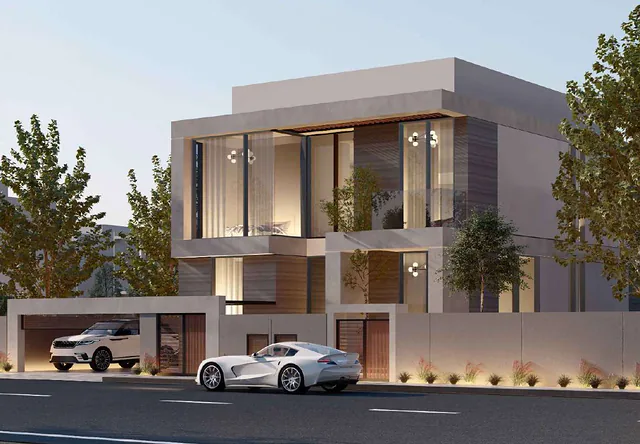
Complex of nine villas, Dubai
Dubai · MEP · Completed
Full MEP for a gated nine-villa compound.
Multi-storey parking & retail centre, DSO
Dubai Silicon Oasis (DSO) · MEP · In progress
G+3 parking and retail centre — MEP works in progress.
G+6 building with health club, DSO
Dubai Silicon Oasis (DSO) · MEP · Completed
Full MEP package delivered.
Driving centre (6 buildings), DIP
Dubai Investments Park (DIP) · HVAC · Completed
HVAC on district cooling with an underground chilled-water network.
Frequently asked questions
Which authorities approve VRF systems in Dubai?
Approvals in Dubai typically involve Dubai Municipality, Dubai Civil Defence, Dubai Electricity & Water Authority and Al Sa'fat — Dubai Green Building Evaluation System. Exact routes depend on the plot, the master developer and whether the site sits in a free zone, so we confirm the authority matrix during mobilisation and prepare submissions accordingly.
What buildings need VRF systems in Dubai?
In Dubai, demand mostly comes from malls and retail centres and palaces and private estates. Each type changes system selection, approvals and programme, which is why we review the building use before pricing.
Is district cooling available in Dubai?
District cooling is common in Dubai, with Empower and Emicool among the providers. Connection terms, energy-transfer-station design and capacity are agreed per plot with the provider, so the HVAC design should confirm availability before choosing between a connection and a dedicated chiller plant.
What similar work has Manolia completed near Dubai?
Relevant reference work includes Complex of nine villas, Dubai (MEP, completed), Multi-storey parking & retail centre, DSO (MEP, in progress) and G+6 building with health club, DSO (MEP, completed). Each reference is listed with its scope and status as recorded in our company profile.
Is VRF a good choice for a villa in Dubai?
For most villas, VRF or ducted split systems are a sensible choice because there is no central plant and rooms need individual control. Manolia has delivered A/C for villas in Dubai, RAK and Emirates Hills, as well as a deluxe semi-palace. The critical points are high-ambient selection, fresh-air treatment and quality refrigerant pipework.
Can VRF serve a multi-storey building?
Yes, within manufacturer limits on height difference and pipe length. Mid-rise offices, hotels and residential buildings commonly use VRF with outdoor units on the roof or on each floor. For tall towers, limits on refrigerant runs and charge usually make chilled water more appropriate.