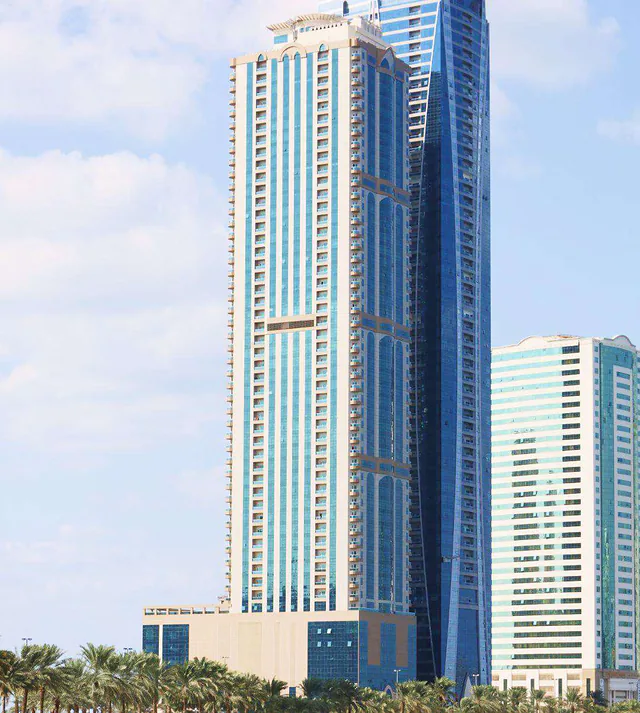
High-rise MEP contracting in Jumeirah Village Circle (JVC): local context
Jumeirah Village Circle is a large community of mid-rise apartment buildings, townhouses and villas between Al Khail Road and Hessa Street, developed in phases since the late 2000s. It has become one of Dubai's busiest areas for mid-market residential construction, with many G+4 to G+20 buildings on individual plots. Construction is still active, so new builds sit next to occupied buildings and narrow internal roads.
- Typical plots have shallow podiums and compact plant rooms, so space for chillers, packaged units, water tanks and fire pumps must be fixed early in coordination with structure.
- Approvals can involve the master developer and Trakhees or Dubai Municipality depending on the plot, with Civil Defence review of fire systems; the route is confirmed per plot.
- Narrow circular roads and neighbouring active sites limit crane and delivery positions, so material drops are coordinated with surrounding contractors.
Building types we serve in Jumeirah Village Circle (JVC)
For high-rise towers, the work concentrates on pressure-zoned water and drainage stacks, riser and plant-room coordination, stair pressurisation and a cooling source sized for diversity across dozens of typical floors.
Approvals and authorities in Jumeirah Village Circle (JVC)
High-rise MEP in Jumeirah Village Circle (JVC) sits within Dubai's regulatory framework. The authorities you will meet are:
- Dubai Municipality (DM)
- Trakhees (PCFC) (Trakhees)
- Dubai Civil Defence (DCD)
- Dubai Electricity & Water Authority (DEWA)
- Al Sa'fat — Dubai Green Building Evaluation System (Al Sa'fat)
- UAE Fire & Life Safety Code of Practice (UAE FLSC)
Scope of work
- Vertical zoning of water supply, chilled water and fire systems to keep pressures within equipment ratings, using pump zones, intermediate plant floors or pressure-reducing stations.
- Riser design and installation for chilled water, drainage, fire mains, electrical busbars and low current, with expansion joints and supports suited to building movement.
- Smoke control and stair pressurisation systems, including fans, dampers and controls, coordinated with fire alarm cause and effect.
- Typical-floor MEP installation using repeatable layouts and prefabrication where possible to speed installation and improve quality.
Systems we install
- Sprinkler risers, landing valves and zoned fire pumps.
- BMS integration for central plant, lifts, life safety and metering.
UAE site and climate challenges
- Roof-level plant on towers faces higher wind and solar exposure and hot air from adjacent equipment. We space condensers, cooling towers and fans to avoid recirculation and size them for real roof conditions near the design limit.
- Stack effect in tall buildings pushes air through stairs and lift shafts, especially with large indoor-outdoor temperature differences. Pressurisation design and door leakage assumptions take this into account so doors remain openable during an emergency.
- District cooling versus own chillers: district cooling avoids roof plant, noise and maintenance staff, but adds connection costs and long-term capacity tariffs that residents or owners ultimately carry.
Relevant Manolia projects
2B+G+15 residential tower, IMPZ
Dubai Production City (formerly IMPZ) · MEP · Completed
Full MEP package for a two-basement residential tower with gym.
G+14 building, Dubailand
Dubailand · HVAC · Completed
HVAC for a 14-storey residential building.
Frequently asked questions
Which authorities approve high-rise MEP in Jumeirah Village Circle (JVC)?
Approvals in Jumeirah Village Circle (JVC) typically involve Dubai Municipality, Trakhees (PCFC), Dubai Civil Defence and Dubai Electricity & Water Authority. Exact routes depend on the plot, the master developer and whether the site sits in a free zone, so we confirm the authority matrix during mobilisation and prepare submissions accordingly.
Can district cooling be used for high-rise towers?
Yes. Many towers in Dubai and Abu Dhabi connect to district cooling. Plate heat exchangers in an energy transfer station separate the building's chilled water from the provider's network, which also helps with pressure zoning, and tenant energy meters handle billing for each unit.