Chilled water piping in Jumeirah Village Circle (JVC): local context
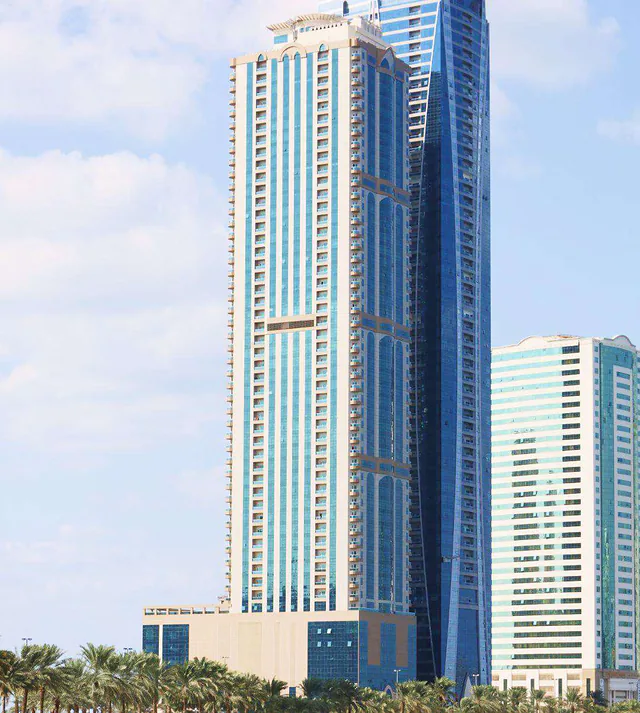
Jumeirah Village Circle is a large community of mid-rise apartment buildings, townhouses and villas between Al Khail Road and Hessa Street, developed in phases since the late 2000s. It has become one of Dubai's busiest areas for mid-market residential construction, with many G+4 to G+20 buildings on individual plots. Construction is still active, so new builds sit next to occupied buildings and narrow internal roads.
- Typical plots have shallow podiums and compact plant rooms, so space for chillers, packaged units, water tanks and fire pumps must be fixed early in coordination with structure.
- Approvals can involve the master developer and Trakhees or Dubai Municipality depending on the plot, with Civil Defence review of fire systems; the route is confirmed per plot.
- Air-cooled chillers or VRF systems on rooftops face high roof temperatures, so selections are derated for summer conditions and placed with enough clearance to avoid hot-air recirculation.
Building types we serve in Jumeirah Village Circle (JVC)
For malls and retail centres, the work concentrates on large-volume air handling, tenant-ready chilled water or refrigerant capacity, smoke extraction for atriums and car parks and food-court exhaust.
Approvals and authorities in Jumeirah Village Circle (JVC)
Chilled water piping in Jumeirah Village Circle (JVC) sits within Dubai's regulatory framework. The authorities you will meet are:
- Dubai Municipality (DM)
- Trakhees (PCFC) (Trakhees)
- Dubai Civil Defence (DCD)
- Dubai Electricity & Water Authority (DEWA)
- Al Sa'fat — Dubai Green Building Evaluation System (Al Sa'fat)
- ASHRAE standards (62.1, 90.1) (ASHRAE)
Scope of work
- Installation of steel or pre-insulated mains, risers and branch pipework with supports, anchors and expansion provisions suited to each route.
- Hydrostatic pressure testing of each section before insulation, followed by full system test before connection to the plant.
- Closed-cell insulation with vapour barrier, aluminium cladding outdoors and labelling with flow direction.
- Strainer and coil bypass arrangements during flushing so debris is collected in temporary screens rather than lodged in new fan coil and AHU coils.
Systems we install
- Pre-insulated buried pipe networks between buildings
- Energy meters at building or tenant connections
UAE site and climate challenges
- Exposed roof pipework sits in direct sun for most of the day, so it receives thicker insulation and UV-protective aluminium cladding to limit heat gain, stop insulation breakdown and keep supply water temperature close to plant output.
- Buried networks in saline or high-water-table ground face corrosion, so pre-insulated systems with protective jackets and sealed joints are used and trenches are backfilled with suitable material.
- Riser pressure ratings in tall buildings, where static head at lower floors may require higher-rated valves and coils, a pressure break with plate heat exchangers, or split riser zones to stay within component limits.
Relevant Manolia projects
2B+G+15 residential tower, IMPZ
Dubai Production City (formerly IMPZ) · MEP · Completed
Full MEP package for a two-basement residential tower with gym.
G+14 building, Dubailand
Dubailand · HVAC · Completed
HVAC for a 14-storey residential building.
Frequently asked questions
Which authorities approve chilled water piping in Jumeirah Village Circle (JVC)?
Approvals in Jumeirah Village Circle (JVC) typically involve Dubai Municipality, Trakhees (PCFC), Dubai Civil Defence and Dubai Electricity & Water Authority. Exact routes depend on the plot, the master developer and whether the site sits in a free zone, so we confirm the authority matrix during mobilisation and prepare submissions accordingly.
What causes condensation on chilled-water pipes in a UAE building?
Condensation appears where insulation is damaged, too thin, or where the vapour barrier is broken at hangers, valves and joints. Humid air reaches the cold pipe surface and moisture forms. Correct thickness, sealed joints, insulated supports and careful inspection are the remedy. Repairs involve drying the pipe and reinstating insulation with a continuous seal.