Chilled water piping in Dubai Production City (formerly IMPZ): local context
Dubai Production City, formerly the International Media Production Zone, is a free zone near Al Khail Road combining residential and office towers with light industrial and media-production facilities. It was largely developed from the mid-2000s. Manolia completed MEP for a 2B+G+15 tower with gym here. Plots here are mid-sized and tightly spaced, with towers sharing service roads and neighbouring construction sites.
- Projects fall under the Dubai Development Authority (DDA) approval channel, with Civil Defence review of fire and life safety systems.
- Towers with two basement levels need car park ventilation, sump pumps, and drainage designed for groundwater and stormwater ingress.
- Office and media spaces require flexible electrical distribution, UPS-backed circuits and dedicated cooling for equipment-heavy rooms with high sensible loads.
Building types we serve in Dubai Production City (formerly IMPZ)
For factories and industrial plants, the work concentrates on process cooling and ventilation, heavy LV distribution, hazard-appropriate fire protection and plant that tolerates dust and high ambient temperatures.
Approvals and authorities in Dubai Production City (formerly IMPZ)
Chilled water piping in Dubai Production City (formerly IMPZ) sits within Dubai's regulatory framework. The authorities you will meet are:
- Dubai Development Authority (DDA)
- Dubai Civil Defence (DCD)
- Dubai Electricity & Water Authority (DEWA)
- Al Sa'fat — Dubai Green Building Evaluation System (Al Sa'fat)
- ASHRAE standards (62.1, 90.1) (ASHRAE)
Scope of work
- Installation of steel or pre-insulated mains, risers and branch pipework with supports, anchors and expansion provisions suited to each route.
- Chemical cleaning and flushing to remove mill scale, debris and welding residue, with water treatment introduced after flushing.
- Closed-cell insulation with vapour barrier, aluminium cladding outdoors and labelling with flow direction.
- Strainer and coil bypass arrangements during flushing so debris is collected in temporary screens rather than lodged in new fan coil and AHU coils.
Systems we install
- Pre-insulated buried pipe networks between buildings
- Y-strainers, flushing bypasses and dirt separators at plant connections
UAE site and climate challenges
- Chilled-water pipes run well below the dew point of humid UAE air, so any gap in the vapour barrier leads to condensation, wet insulation and dripping ceilings; joints, supports and valves are therefore inspected before ceilings close.
- Exposed roof pipework sits in direct sun for most of the day, so it receives thicker insulation and UV-protective aluminium cladding to limit heat gain, stop insulation breakdown and keep supply water temperature close to plant output.
- Steel versus pre-insulated or alternative pipe systems: welded or grooved steel remains standard for risers and plant rooms, while pre-insulated pipe suits buried routes between buildings and saves on-site insulation labour.
Relevant Manolia projects
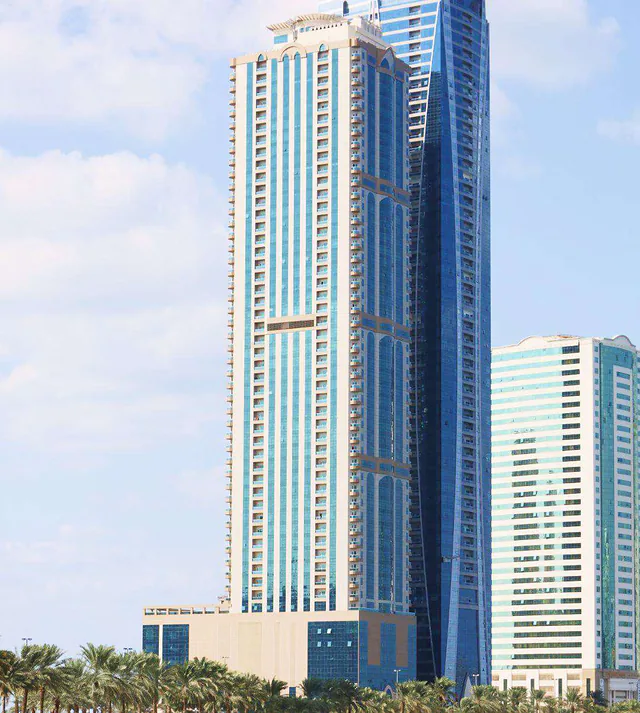
2B+G+15 residential tower, IMPZ
Dubai Production City (formerly IMPZ) · MEP · Completed
Full MEP package for a two-basement residential tower with gym.
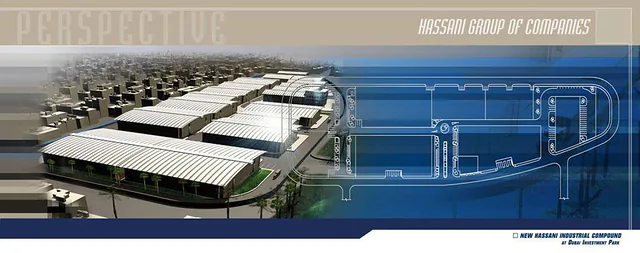
Hassani Group factories & HQ, DIP
Dubai Investments Park (DIP) · MEP · Completed
Factory complex, HQ and staff accommodation, all served from one central cooling station.
Frequently asked questions
Which authorities approve chilled water piping in Dubai Production City (formerly IMPZ)?
Approvals in Dubai Production City (formerly IMPZ) typically involve Dubai Development Authority, Dubai Civil Defence, Dubai Electricity & Water Authority and Al Sa'fat — Dubai Green Building Evaluation System. Exact routes depend on the plot, the master developer and whether the site sits in a free zone, so we confirm the authority matrix during mobilisation and prepare submissions accordingly.
What causes condensation on chilled-water pipes in a UAE building?
Condensation appears where insulation is damaged, too thin, or where the vapour barrier is broken at hangers, valves and joints. Humid air reaches the cold pipe surface and moisture forms. Correct thickness, sealed joints, insulated supports and careful inspection are the remedy. Repairs involve drying the pipe and reinstating insulation with a continuous seal.