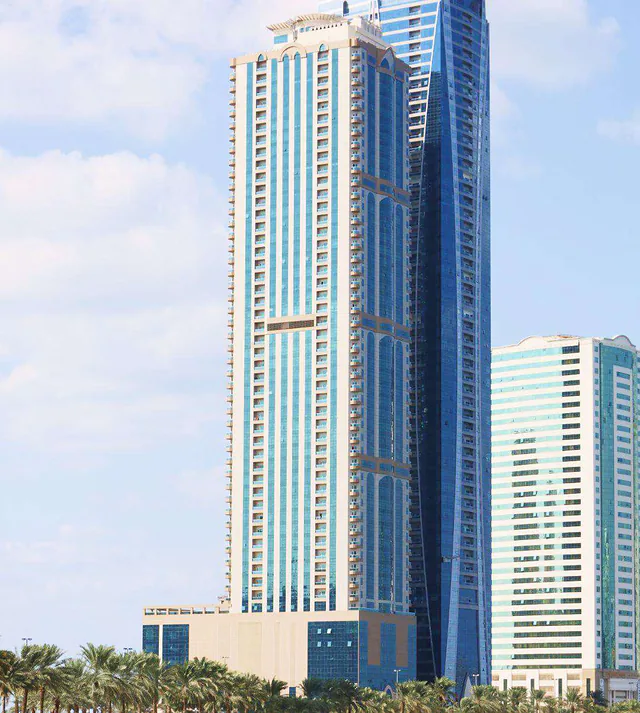
High-rise MEP contracting in Dubai Production City (formerly IMPZ): local context
Dubai Production City, formerly the International Media Production Zone, is a free zone near Al Khail Road combining residential and office towers with light industrial and media-production facilities. It was largely developed from the mid-2000s. Manolia completed MEP for a 2B+G+15 tower with gym here. Plots here are mid-sized and tightly spaced, with towers sharing service roads and neighbouring construction sites.
- Projects fall under the Dubai Development Authority (DDA) approval channel, with Civil Defence review of fire and life safety systems.
- Towers with two basement levels need car park ventilation, sump pumps, and drainage designed for groundwater and stormwater ingress.
- The area is inland and dusty, so condenser cleaning and filter access are planned into the design.
Building types we serve in Dubai Production City (formerly IMPZ)
For high-rise towers, the work concentrates on pressure-zoned water and drainage stacks, riser and plant-room coordination, stair pressurisation and a cooling source sized for diversity across dozens of typical floors.
Approvals and authorities in Dubai Production City (formerly IMPZ)
High-rise MEP in Dubai Production City (formerly IMPZ) sits within Dubai's regulatory framework. The authorities you will meet are:
- Dubai Development Authority (DDA)
- Dubai Civil Defence (DCD)
- Dubai Electricity & Water Authority (DEWA)
- Al Sa'fat — Dubai Green Building Evaluation System (Al Sa'fat)
- UAE Fire & Life Safety Code of Practice (UAE FLSC)
Scope of work
- Vertical zoning of water supply, chilled water and fire systems to keep pressures within equipment ratings, using pump zones, intermediate plant floors or pressure-reducing stations.
- Smoke control and stair pressurisation systems, including fans, dampers and controls, coordinated with fire alarm cause and effect.
- Typical-floor MEP installation using repeatable layouts and prefabrication where possible to speed installation and improve quality.
- Testing, commissioning and phased handover by floors or zones as required by the developer, with life-safety systems proven before any floor is occupied.
Systems we install
- Busbar risers, floor DBs, emergency generators and life-safety panels.
- BMS integration for central plant, lifts, life safety and metering.
UAE site and climate challenges
- Tall buildings in humid coastal areas need strict control of outdoor air at each floor. Dedicated fresh-air units with dehumidification prevent condensation on ceilings and moisture problems in corridors and apartments.
- Sealed-facade towers depend entirely on mechanical ventilation. Fresh-air intakes are separated from kitchen exhaust, toilet extract and generator flues so polluted air is not drawn back into apartments, especially on still, humid summer nights.
- District cooling versus own chillers: district cooling avoids roof plant, noise and maintenance staff, but adds connection costs and long-term capacity tariffs that residents or owners ultimately carry.
Relevant Manolia projects
2B+G+15 residential tower, IMPZ
Dubai Production City (formerly IMPZ) · MEP · Completed
Full MEP package for a two-basement residential tower with gym.
G+14 building, Dubailand
Dubailand · HVAC · Completed
HVAC for a 14-storey residential building.
Frequently asked questions
Which authorities approve high-rise MEP in Dubai Production City (formerly IMPZ)?
Approvals in Dubai Production City (formerly IMPZ) typically involve Dubai Development Authority, Dubai Civil Defence, Dubai Electricity & Water Authority and Al Sa'fat — Dubai Green Building Evaluation System. Exact routes depend on the plot, the master developer and whether the site sits in a free zone, so we confirm the authority matrix during mobilisation and prepare submissions accordingly.
What is stair pressurisation?
It is a system that pushes air into stairwells during a fire to keep smoke out and protect escape routes. Fans, relief dampers and controls are designed and tested so pressure is high enough to block smoke but low enough that occupants can still open the stair doors.