Industrial and factory MEP in Dubai Production City (formerly IMPZ): local context
Dubai Production City, formerly the International Media Production Zone, is a free zone near Al Khail Road combining residential and office towers with light industrial and media-production facilities. It was largely developed from the mid-2000s. Manolia completed MEP for a 2B+G+15 tower with gym here. Plots here are mid-sized and tightly spaced, with towers sharing service roads and neighbouring construction sites.
- Towers with two basement levels need car park ventilation, sump pumps, and drainage designed for groundwater and stormwater ingress.
- Office and media spaces require flexible electrical distribution, UPS-backed circuits and dedicated cooling for equipment-heavy rooms with high sensible loads.
- The area is inland and dusty, so condenser cleaning and filter access are planned into the design.
Building types we serve in Dubai Production City (formerly IMPZ)
For factories and industrial plants, the work concentrates on process cooling and ventilation, heavy LV distribution, hazard-appropriate fire protection and plant that tolerates dust and high ambient temperatures.
Approvals and authorities in Dubai Production City (formerly IMPZ)
Factory MEP in Dubai Production City (formerly IMPZ) sits within Dubai's regulatory framework. The authorities you will meet are:
- Dubai Development Authority (DDA)
- Dubai Civil Defence (DCD)
- Dubai Electricity & Water Authority (DEWA)
- Al Sa'fat — Dubai Green Building Evaluation System (Al Sa'fat)
- UAE Fire & Life Safety Code of Practice (UAE FLSC)
Scope of work
- Review of process heat loads, product temperature and humidity limits, and production schedules with the operator before selecting cooling and ventilation systems.
- Process and general ventilation, local exhaust at heat or fume sources, and make-up air arranged to avoid drawing dust into production areas.
- LV distribution from main switchboards to motor control centres, production machine feeds, lighting and small power, with power factor correction where loads justify it.
- Compressed air, process water and industrial drainage provisions coordinated with machine layouts and the operator's equipment suppliers.
Systems we install
- AHUs with tight temperature and humidity control for food and chocolate production rooms.
- Motor control centres, capacitor banks and heavy-duty cable tray systems for machines.
UAE site and climate challenges
- Factory roofs absorb intense solar heat, and large metal-clad halls can exceed comfortable temperatures even with cooling. Roof insulation coordination, high-level heat extraction and targeted spot cooling for workers reduce loads compared with cooling the whole volume.
- Electrical rooms in factories run hot with large switchgear and variable speed drives. Dedicated cooling for electrical rooms prevents nuisance tripping and extends equipment life.
- Full air conditioning versus ventilation with spot cooling: full cooling suits sensitive products such as chocolate and packaging film, while ventilation with spot cooling suits heavy industry where process heat dominates.
Relevant Manolia projects
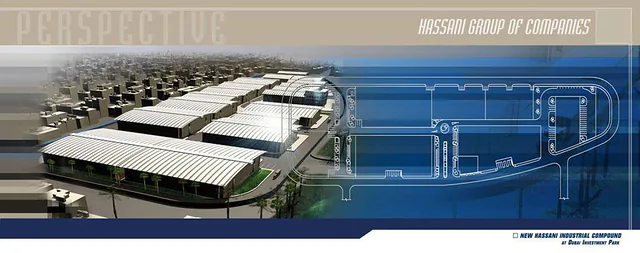
Hassani Group factories & HQ, DIP
Dubai Investments Park (DIP) · MEP · Completed
Factory complex, HQ and staff accommodation, all served from one central cooling station.
International Clear Packaging factory, Abu Dhabi
KEZAD (Khalifa Economic Zones Abu Dhabi) · HVAC · Completed
HVAC for a factory in a specialised economic zone.
Frequently asked questions
Which authorities approve factory MEP in Dubai Production City (formerly IMPZ)?
Approvals in Dubai Production City (formerly IMPZ) typically involve Dubai Development Authority, Dubai Civil Defence, Dubai Electricity & Water Authority and Al Sa'fat — Dubai Green Building Evaluation System. Exact routes depend on the plot, the master developer and whether the site sits in a free zone, so we confirm the authority matrix during mobilisation and prepare submissions accordingly.
What MEP systems does a factory need?
Typically power distribution to machines and lighting, cooling or ventilation, water supply and drainage, fire protection and sometimes compressed air or process cooling. The exact mix depends on the process, product requirements and the number of workers, and should be defined with the operator early.