
Ductwork installation in Sharjah: local context
Sharjah combines a dense band of 20–30 storey residential towers along Al Nahda, Al Taawun, Al Khan and Al Majaz with older mid-rise stock, large industrial areas and newer master-planned communities such as Aljada and Tilal City further inland. Much of its housing serves people who work in Dubai, so residential towers with podium car parks dominate the urban core. MEP work here is shaped by SEWA utility requirements, Sharjah Civil Defence review, and a high share of retrofit and replacement work in buildings that are 15–30 years old. Manolia has a long record in Sharjah, from residential towers to the American University of Sharjah campus.
MEP drawings typically go through Sharjah Municipality as part of the building permit, with Sharjah Civil Defence approving fire and life safety designs and inspecting installed systems before occupancy. SEWA handles electrical load, water and gas connection approvals and final inspections. In free zones or master-planned communities, a developer or zone NOC usually comes first; the route is confirmed per plot.
- Sharjah Civil Defence reviews fire alarm, firefighting, smoke extract and emergency lighting designs, and many older towers need upgrades to bring fire systems in line with the current UAE Fire & Life Safety Code during refurbishment.
- Lagoon-side districts such as Al Khan, Al Majaz and Al Taawun are humid and salt-laden, so condenser coil coatings, galvanised or stainless supports and careful condensate drainage design matter more than on inland plots.
Building types we serve in Sharjah
For factories and industrial plants, the work concentrates on process cooling and ventilation, heavy LV distribution, hazard-appropriate fire protection and plant that tolerates dust and high ambient temperatures.
For office buildings, the work concentrates on VAV or FCU zoning for flexible floor plates, tenant fit-out interfaces, energy metering and BMS integration.
Approvals and authorities in Sharjah
Ductwork installation in Sharjah sits within Sharjah's regulatory framework. The authorities you will meet are:
- Sharjah Municipality (SM)
- Sharjah Civil Defence (SCD)
- Sharjah Electricity, Water & Gas Authority (SEWA)
- ASHRAE standards (62.1, 90.1) (ASHRAE)
- UAE Fire & Life Safety Code of Practice (UAE FLSC)
Scope of work
- Fabrication of galvanised steel ducts to specified gauge and pressure class, with proper seams, stiffening and sealing.
- Installation with hangers, supports and seismic or vibration provisions, and flexible connections at fan outlets.
- Fire dampers and smoke dampers at compartment boundaries, installed in approved frames with access panels for inspection.
- Thermal insulation with vapour barrier on supply and fresh-air ducts, plus acoustic lining where noise criteria require it.
- Grilles, diffusers and volume control dampers installed and set during air balancing.
Systems we install
- Pre-insulated phenolic or similar panel ductwork where specified
- Fire, smoke and combination fire-smoke dampers
- Volume control and motorised dampers
UAE site and climate challenges
- Cold supply ducts in humid ceiling voids sweat if insulation is thin or the vapour barrier is punctured at hangers, so insulated supports and taped joints are checked before ceilings are installed.
- Ducts running in roof spaces or exposed on roofs gain heat from intense sun, so thicker insulation with weatherproof cladding is used to protect cooling capacity and keep supply air close to design temperature.
Decisions to make early
- Duct velocity and size, trading ceiling space against fan energy and noise: smaller ducts save void depth but require higher fan pressure and can whistle at grilles in quiet rooms.
- Diffuser type, balancing appearance and throw against cost: linear slot diffusers look clean in premium interiors but need careful balancing to avoid draughts and dumping of cold air.
Relevant Manolia projects
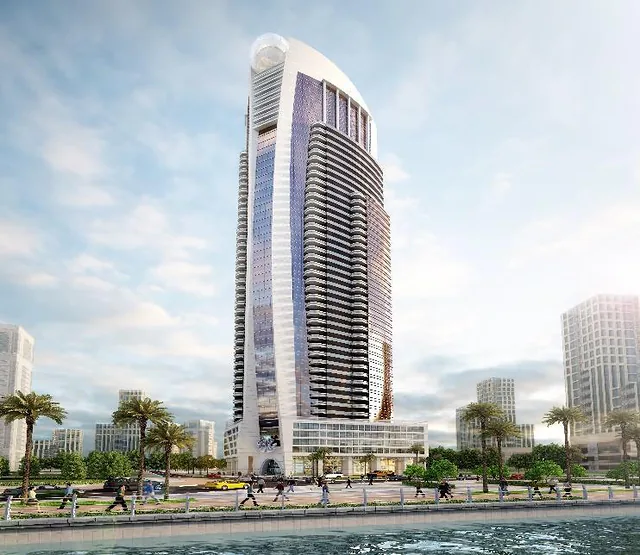
Al Mazroaa Tower, Sharjah
Sharjah · HVAC · Completed
HVAC for a 43-typical-floor tower with health club.
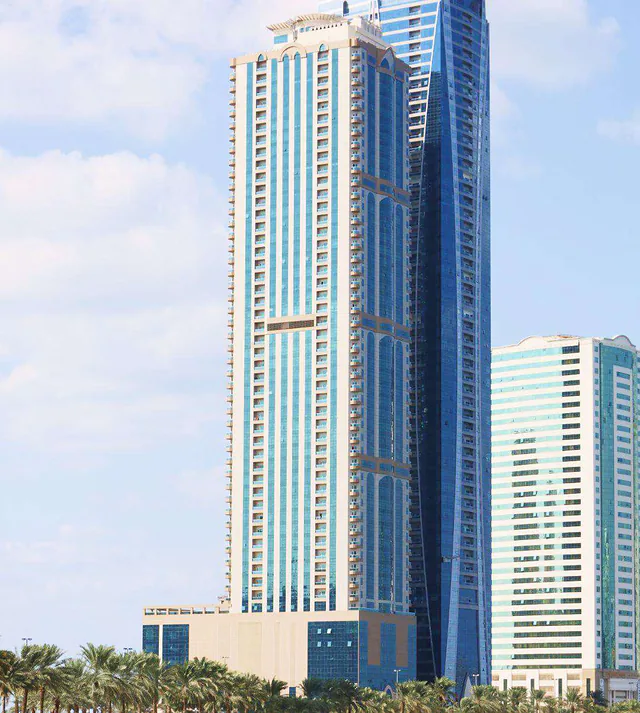
Al Salam Tower, Sharjah
Sharjah · HVAC · Completed
Chiller plant and roof chilled-water network for a 52-typical-floor tower.
Al Mawared Twin Tower, Sharjah
Sharjah · HVAC · Completed
HVAC for twin 32-typical-floor towers.
G+28 residential tower, Sharjah
Sharjah · MEP · Completed
Full MEP subcontract for a 28-storey tower.
Frequently asked questions
Which authorities approve ductwork installation in Sharjah?
Approvals in Sharjah typically involve Sharjah Municipality, Sharjah Civil Defence, Sharjah Electricity, Water & Gas Authority and ASHRAE standards (62.1, 90.1). Exact routes depend on the plot, the master developer and whether the site sits in a free zone, so we confirm the authority matrix during mobilisation and prepare submissions accordingly.
What buildings need ductwork installation in Sharjah?
In Sharjah, demand mostly comes from factories and industrial plants and office buildings. Each type changes system selection, approvals and programme, which is why we review the building use before pricing.
Does Manolia work in Sharjah?
Yes. Sharjah is in Sharjah, roughly 20–60 minutes from central Dubai depending on traffic. Site teams are mobilised from our Dubai headquarters with supervision, QA/QC and HSE staff assigned to each project.
What similar work has Manolia completed near Sharjah?
Relevant reference work includes Al Mazroaa Tower, Sharjah (HVAC, completed), Al Salam Tower, Sharjah (HVAC, completed) and Al Mawared Twin Tower, Sharjah (HVAC, completed). Each reference is listed with its scope and status as recorded in our company profile.
Where are fire dampers required?
Fire dampers are generally needed where ducts pass through fire-rated walls and floors, as defined by the UAE Fire & Life Safety Code and the approved fire strategy. They must be installed in the correct frame with access for inspection, and Civil Defence inspects them before approval.
Can ductwork cause condensation stains on ceilings?
Yes. If supply ducts are poorly insulated or the vapour barrier is broken, moisture forms on the outside of the duct and drips onto ceiling tiles. Proper insulation, sealed joints and insulated hangers prevent this, which is why insulation is inspected before ceilings close.