Chiller installation in Dubailand: local context
Dubailand is a vast inland zone off the Emirates Road and Al Ain Road that has been carved into many master-planned communities, from townhouse and villa clusters to mid- and high-rise residential, developed in phases since the 2000s and still being built out. Plots range from single buildings to whole neighbourhoods under one developer. Manolia completed HVAC works for a G+14 residential tower with gym here.
- Inland plots see some of the highest ambient temperatures in Dubai, so air-cooled chillers and VRF condensers are selected with high-ambient derating and placed to avoid hot-air recirculation on crowded roofs.
- Open desert around active plots drives sand into condenser coils, louvres and AHU intakes, so sand-trap louvres, pre-filters and easy coil-cleaning access are worth designing in from the start.
- Approvals frequently start with a master developer NOC for the specific community before Dubai Municipality and Civil Defence submissions, and infrastructure handover timing can affect when DEWA connections are available.
Building types we serve in Dubailand
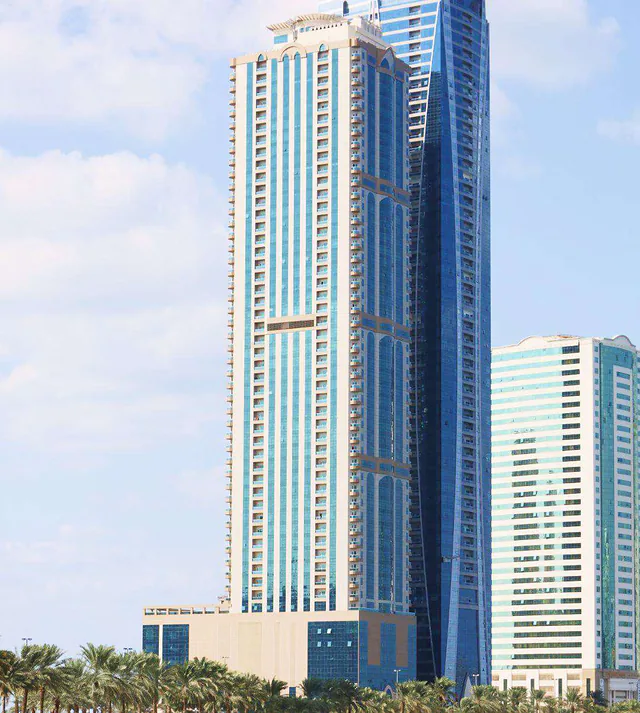
For high-rise towers, the work concentrates on pressure-zoned water and drainage stacks, riser and plant-room coordination, stair pressurisation and a cooling source sized for diversity across dozens of typical floors.
Approvals and authorities in Dubailand
Chiller installation in Dubailand sits within Dubai's regulatory framework. The authorities you will meet are:
- Dubai Municipality (DM)
- Dubai Civil Defence (DCD)
- Dubai Electricity & Water Authority (DEWA)
- Al Sa'fat — Dubai Green Building Evaluation System (Al Sa'fat)
- ASHRAE standards (62.1, 90.1) (ASHRAE)
Scope of work
- Review of plant capacity, redundancy and part-load profile so the number and size of chillers matches how the building actually operates through the year.
- Structural and acoustic coordination for roof or plant-room locations, including spring isolators, inertia bases and maintenance clearances around each machine.
- Rigging and lifting plans for heavy chillers onto roofs or into basements, coordinated with crane availability and site logistics.
- Plant manager and BMS integration for sequencing, staging and alarm reporting, followed by manufacturer start-up and performance verification.
Systems we install
- Chemical dosing and side-stream filtration on the chilled-water loop
- Thermal energy storage tanks where tariffs or loads justify
UAE site and climate challenges
- Air-cooled chillers lose capacity as condenser inlet air rises, and UAE design conditions around 46 to 50°C mean machines must be selected for that ambient, not catalogue ratings at 35°C, or the plant will fall short on peak days.
- Hot discharge air recirculating between closely spaced roof chillers raises inlet temperatures further, so layout, screen walls and spacing are checked against manufacturer clearance guidance.
- Air-cooled versus water-cooled: air-cooled needs no cooling tower or water treatment and suits most towers, while water-cooled is more efficient but needs make-up water, treatment and more maintenance.
Relevant Manolia projects
Multi-storey parking & retail centre, DSO
Dubai Silicon Oasis (DSO) · MEP · In progress
G+3 parking and retail centre — MEP works in progress.
2B+G+15 residential tower, IMPZ
Dubai Production City (formerly IMPZ) · MEP · Completed
Full MEP package for a two-basement residential tower with gym.
Frequently asked questions
Which authorities approve chiller installation in Dubailand?
Approvals in Dubailand typically involve Dubai Municipality, Dubai Civil Defence, Dubai Electricity & Water Authority and Al Sa'fat — Dubai Green Building Evaluation System. Exact routes depend on the plot, the master developer and whether the site sits in a free zone, so we confirm the authority matrix during mobilisation and prepare submissions accordingly.
Can existing chillers be replaced while the building is occupied?
Usually yes, with phasing. Where there are multiple chillers, one is replaced at a time while others carry the load, ideally in cooler months. Temporary chillers can be hired if there is a single machine. Rigging routes, power isolation and pipework tie-ins are planned to keep downtime short.