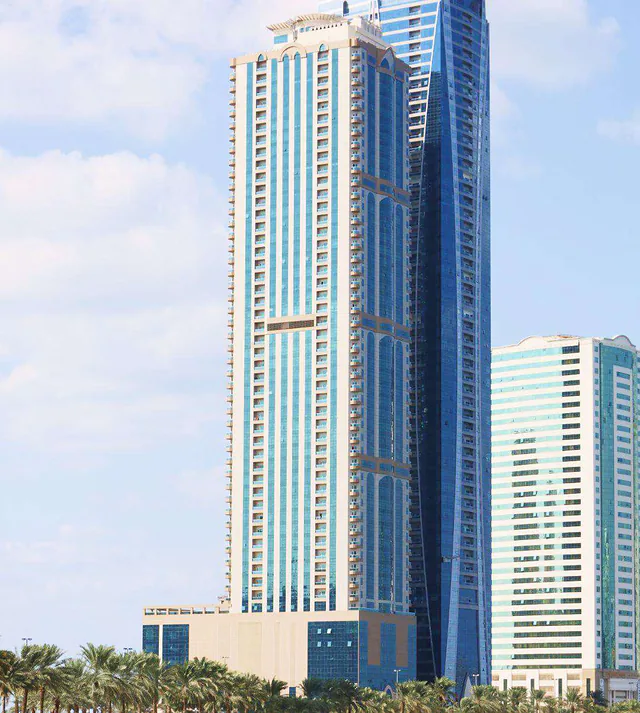
Chilled water piping in Dubailand: local context
Dubailand is a vast inland zone off the Emirates Road and Al Ain Road that has been carved into many master-planned communities, from townhouse and villa clusters to mid- and high-rise residential, developed in phases since the 2000s and still being built out. Plots range from single buildings to whole neighbourhoods under one developer. Manolia completed HVAC works for a G+14 residential tower with gym here.
- Inland plots see some of the highest ambient temperatures in Dubai, so air-cooled chillers and VRF condensers are selected with high-ambient derating and placed to avoid hot-air recirculation on crowded roofs.
- Open desert around active plots drives sand into condenser coils, louvres and AHU intakes, so sand-trap louvres, pre-filters and easy coil-cleaning access are worth designing in from the start.
- Approvals frequently start with a master developer NOC for the specific community before Dubai Municipality and Civil Defence submissions, and infrastructure handover timing can affect when DEWA connections are available.
Building types we serve in Dubailand
For malls and retail centres, the work concentrates on large-volume air handling, tenant-ready chilled water or refrigerant capacity, smoke extraction for atriums and car parks and food-court exhaust.
Approvals and authorities in Dubailand
Chilled water piping in Dubailand sits within Dubai's regulatory framework. The authorities you will meet are:
- Dubai Municipality (DM)
- Dubai Civil Defence (DCD)
- Dubai Electricity & Water Authority (DEWA)
- Al Sa'fat — Dubai Green Building Evaluation System (Al Sa'fat)
- ASHRAE standards (62.1, 90.1) (ASHRAE)
Scope of work
- Installation of steel or pre-insulated mains, risers and branch pipework with supports, anchors and expansion provisions suited to each route.
- Chemical cleaning and flushing to remove mill scale, debris and welding residue, with water treatment introduced after flushing.
- Closed-cell insulation with vapour barrier, aluminium cladding outdoors and labelling with flow direction.
- Strainer and coil bypass arrangements during flushing so debris is collected in temporary screens rather than lodged in new fan coil and AHU coils.
Systems we install
- Pre-insulated buried pipe networks between buildings
- Energy meters at building or tenant connections
UAE site and climate challenges
- Exposed roof pipework sits in direct sun for most of the day, so it receives thicker insulation and UV-protective aluminium cladding to limit heat gain, stop insulation breakdown and keep supply water temperature close to plant output.
- Riser shafts open to outdoor air during construction fill with dust and humidity, so insulation is installed only after shafts are closed and pipes are clean and dry, avoiding trapped moisture under the vapour barrier.
- Two-pipe versus four-pipe distribution: almost all UAE buildings need cooling only, so two-pipe is standard, but hospitals, laboratories or palaces needing reheat for humidity control may justify a separate heating loop.
Relevant Manolia projects
Multi-storey parking & retail centre, DSO
Dubai Silicon Oasis (DSO) · MEP · In progress
G+3 parking and retail centre — MEP works in progress.
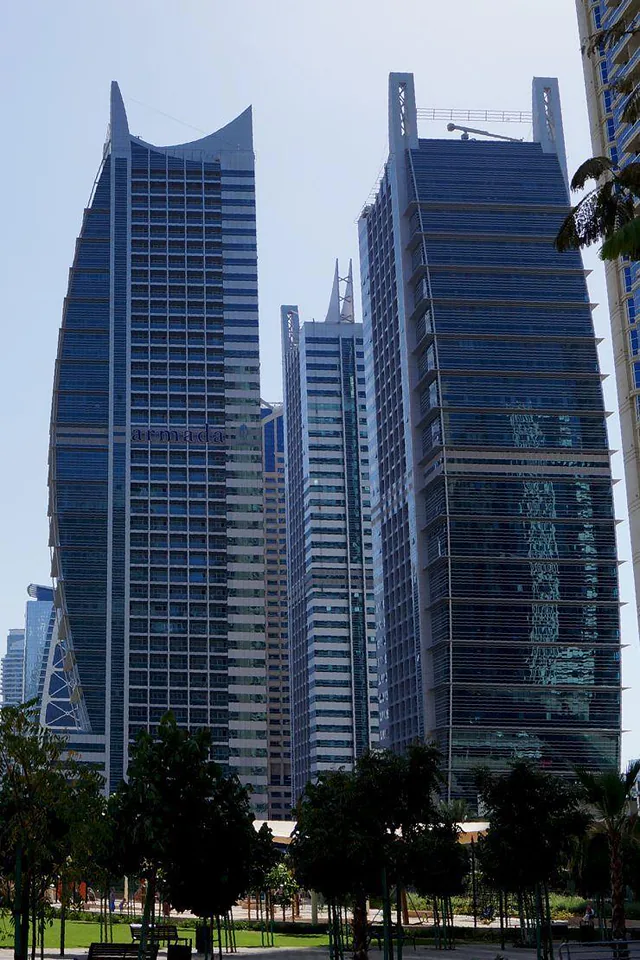
Armada Tower hotel, JLT
Jumeirah Lakes Towers (JLT) · MEP · Completed
MEP for the hotel tower of the three-building Armada Towers cluster.
Frequently asked questions
Which authorities approve chilled water piping in Dubailand?
Approvals in Dubailand typically involve Dubai Municipality, Dubai Civil Defence, Dubai Electricity & Water Authority and Al Sa'fat — Dubai Green Building Evaluation System. Exact routes depend on the plot, the master developer and whether the site sits in a free zone, so we confirm the authority matrix during mobilisation and prepare submissions accordingly.
What causes condensation on chilled-water pipes in a UAE building?
Condensation appears where insulation is damaged, too thin, or where the vapour barrier is broken at hangers, valves and joints. Humid air reaches the cold pipe surface and moisture forms. Correct thickness, sealed joints, insulated supports and careful inspection are the remedy. Repairs involve drying the pipe and reinstating insulation with a continuous seal.