Chilled water piping in Meydan: local context
Meydan is the master-planned area surrounding the Meydan racecourse between Al Khail Road and Ras Al Khor, developed largely since the 2010s. It includes villa and townhouse communities, mid- and high-rise residential, hotels and the racecourse grandstand, with new neighbourhoods still being delivered. Building quality expectations are high and much of the area is under active construction. Its proximity to Business Bay and Downtown makes it a sought-after address for new high-end residential schemes.
- New villa and townhouse clusters connect to community infrastructure that may be handed over in phases, so DEWA connection timing and temporary power for testing should be planned early.
- High-rise residential towers need domestic water pressure zoning with PRV stations, fire pump and tank sizing for height, and stair pressurisation coordinated with the smoke control strategy.
- Master developer design guidelines and NOCs typically precede Dubai Municipality and Civil Defence submissions, and may set rules for rooftop equipment visibility and screening.
Building types we serve in Meydan
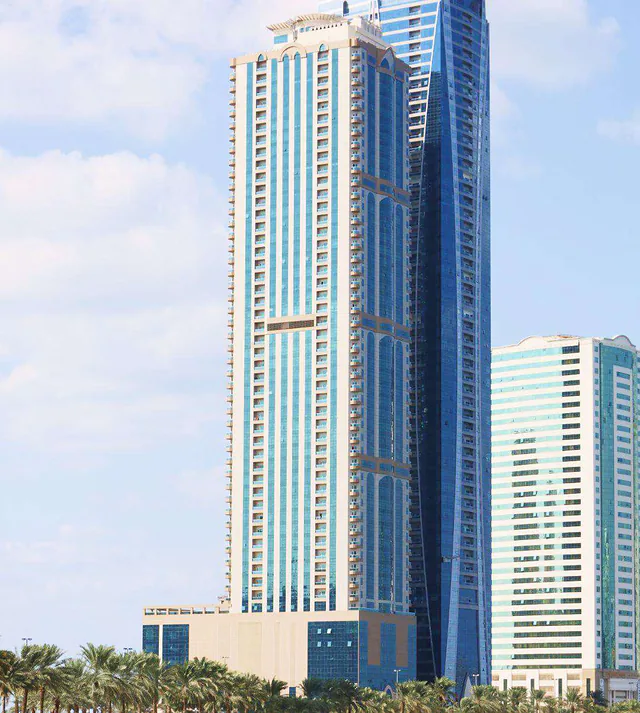
For high-rise towers, the work concentrates on pressure-zoned water and drainage stacks, riser and plant-room coordination, stair pressurisation and a cooling source sized for diversity across dozens of typical floors.
Approvals and authorities in Meydan
Chilled water piping in Meydan sits within Dubai's regulatory framework. The authorities you will meet are:
- Dubai Municipality (DM)
- Dubai Civil Defence (DCD)
- Dubai Electricity & Water Authority (DEWA)
- Al Sa'fat — Dubai Green Building Evaluation System (Al Sa'fat)
- ASHRAE standards (62.1, 90.1) (ASHRAE)
Scope of work
- Pipe sizing review against design flows and allowable pressure drop, with velocity checks to limit noise in risers and erosion at fittings.
- Installation of steel or pre-insulated mains, risers and branch pipework with supports, anchors and expansion provisions suited to each route.
- Underground pre-insulated chilled-water networks between buildings, with trench coordination, leak detection wiring where specified and protected crossings.
- Chemical cleaning and flushing to remove mill scale, debris and welding residue, with water treatment introduced after flushing.
Systems we install
- Pre-insulated buried pipe networks between buildings
- Pressure independent control valves at fan coils and AHUs
UAE site and climate challenges
- Chilled-water pipes run well below the dew point of humid UAE air, so any gap in the vapour barrier leads to condensation, wet insulation and dripping ceilings; joints, supports and valves are therefore inspected before ceilings close.
- Buried networks in saline or high-water-table ground face corrosion, so pre-insulated systems with protective jackets and sealed joints are used and trenches are backfilled with suitable material.
- Two-pipe versus four-pipe distribution: almost all UAE buildings need cooling only, so two-pipe is standard, but hospitals, laboratories or palaces needing reheat for humidity control may justify a separate heating loop.
Relevant Manolia projects
G+14 building, Dubailand
Dubailand · HVAC · Completed
HVAC for a 14-storey residential building.
Driving centre (6 buildings), DIP
Dubai Investments Park (DIP) · HVAC · Completed
HVAC on district cooling with an underground chilled-water network.
Frequently asked questions
Which authorities approve chilled water piping in Meydan?
Approvals in Meydan typically involve Dubai Municipality, Dubai Civil Defence, Dubai Electricity & Water Authority and Al Sa'fat — Dubai Green Building Evaluation System. Exact routes depend on the plot, the master developer and whether the site sits in a free zone, so we confirm the authority matrix during mobilisation and prepare submissions accordingly.
Has Manolia installed underground chilled-water networks?
Yes. On a six-building G+2 driving centre at Dubai Industrial Park, Manolia's HVAC scope included district cooling with an underground chilled-water network. The Hassani Group complex at DIP, a group of factories and headquarters, was also served from one cooling station through a site network. Both projects involved coordinating trenches, sleeves and connections with other site services.