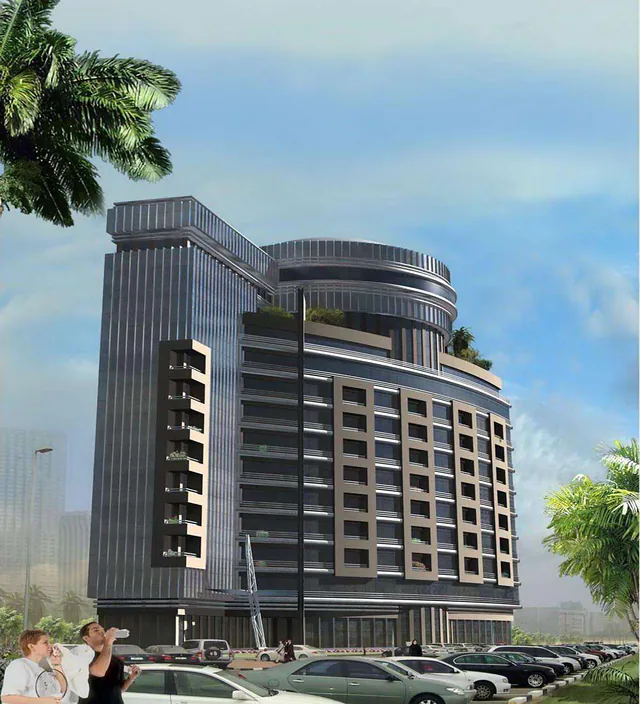
Residential building construction in Jumeirah Lakes Towers (JLT): local context
Jumeirah Lakes Towers is a DMCC free-zone district of around 80 towers arranged in clusters around artificial lakes, opposite Dubai Marina along Sheikh Zayed Road. Built mostly in the late 2000s, it mixes office, residential and hotel towers with ground-level retail and clinics. Manolia completed the MEP works for the Armada hotel tower (G+50) and MEP for the Armada surgical centre here.
- Empower supplies district cooling to much of JLT, so tower scopes typically include energy transfer stations, secondary chilled-water pumping, and careful control of return temperature to keep tariffs and plant performance in check.
- Construction and modification approvals run through DMCC's building authority channel rather than Dubai Municipality, with Civil Defence review of fire and life safety drawings; the exact steps depend on the cluster and works.
- Clusters share podiums and access roads, so loading bays, hoist time and crane positions are negotiated with neighbouring towers and cluster management.
Building types we serve in Jumeirah Lakes Towers (JLT)
For high-rise towers, the work concentrates on pressure-zoned water and drainage stacks, riser and plant-room coordination, stair pressurisation and a cooling source sized for diversity across dozens of typical floors.
Approvals and authorities in Jumeirah Lakes Towers (JLT)
Residential construction in Jumeirah Lakes Towers (JLT) sits within Dubai's regulatory framework. The authorities you will meet are:
- DMCC Authority (DMCC)
- Dubai Civil Defence (DCD)
- Dubai Electricity & Water Authority (DEWA)
- Al Sa'fat — Dubai Green Building Evaluation System (Al Sa'fat)
- UAE Fire & Life Safety Code of Practice (UAE FLSC)
Scope of work
- Review of residential layouts for buildability, unit repetition, shaft positions and ceiling heights so MEP fits without lowering ceilings in living spaces.
- Foundations, basements and podium car parks, with waterproofing and ventilation of car parks coordinated from the start.
- Common areas including lobbies, corridors, gyms and pool decks, coordinated with lifts, access control and building services so ceilings and finishes are not reopened.
- Full MEP installation, testing and handover through group companies, including individual utility metering per unit and coordination of utility connections.
Systems we install
- Reinforced concrete frames with repetitive typical floors and transfer slabs where required.
- Apartment HVAC by district cooling, central chilled water or VRF.
UAE site and climate challenges
- Condensation in corridors and on window frames is common when humid air leaks into cooled apartments. Air-tightness of windows and doors, plus dehumidified corridor fresh air, reduces moisture problems.
- Basement car parks get hot and polluted. Jet fan or ducted ventilation designed with CO detection keeps air quality acceptable and supports smoke clearance in fire mode.
- Precast versus cast-in-place elements: precast stairs, balconies or facade panels speed some works and improve consistency, but require an early design freeze and suitable crane and access planning.
Relevant Manolia projects
200 villas, Emirates Hills
Emirates Hills · MEP · Completed
MEP works across a 200-villa residential package.
2B+G+15 residential tower, IMPZ
Dubai Production City (formerly IMPZ) · MEP · Completed
Full MEP package for a two-basement residential tower with gym.
Frequently asked questions
Which authorities approve residential construction in Jumeirah Lakes Towers (JLT)?
Approvals in Jumeirah Lakes Towers (JLT) typically involve DMCC Authority, Dubai Civil Defence, Dubai Electricity & Water Authority and Al Sa'fat — Dubai Green Building Evaluation System. Exact routes depend on the plot, the master developer and whether the site sits in a free zone, so we confirm the authority matrix during mobilisation and prepare submissions accordingly.
How are water leaks prevented in apartments?
By inspecting and flood-testing waterproofing in wet areas, balconies and roofs before screeds and tiles, pressure-testing water pipes before walls and ceilings are closed, and coordinating penetrations so membranes are not cut by later trades. Records of these tests form part of the handover documentation.