District cooling connection in Jumeirah Lakes Towers (JLT): local context
Jumeirah Lakes Towers is a DMCC free-zone district of around 80 towers arranged in clusters around artificial lakes, opposite Dubai Marina along Sheikh Zayed Road. Built mostly in the late 2000s, it mixes office, residential and hotel towers with ground-level retail and clinics. Manolia completed the MEP works for the Armada hotel tower (G+50) and MEP for the Armada surgical centre here.
- Empower supplies district cooling to much of JLT, so tower scopes typically include energy transfer stations, secondary chilled-water pumping, and careful control of return temperature to keep tariffs and plant performance in check.
- Construction and modification approvals run through DMCC's building authority channel rather than Dubai Municipality, with Civil Defence review of fire and life safety drawings; the exact steps depend on the cluster and works.
- Clusters share podiums and access roads, so loading bays, hoist time and crane positions are negotiated with neighbouring towers and cluster management.
Building types we serve in Jumeirah Lakes Towers (JLT)
For office buildings, the work concentrates on VAV or FCU zoning for flexible floor plates, tenant fit-out interfaces, energy metering and BMS integration.
Approvals and authorities in Jumeirah Lakes Towers (JLT)
District cooling connection in Jumeirah Lakes Towers (JLT) sits within Dubai's regulatory framework. The authorities you will meet are:
- DMCC Authority (DMCC)
- Dubai Civil Defence (DCD)
- Dubai Electricity & Water Authority (DEWA)
- Al Sa'fat — Dubai Green Building Evaluation System (Al Sa'fat)
- ASHRAE standards (62.1, 90.1) (ASHRAE)
Scope of work
- Review of the provider's connection agreement and technical requirements, including supply temperatures, return temperature commitments and metering arrangements.
- Coordination of the provider's incoming pipes, sleeve positions and meter locations with the building structure and other services in the ETS room.
- Pressure testing, flushing and water quality verification of the secondary system before provider inspection and connection.
- Joint commissioning with the provider, including witnessed tests and handover of meter readings at energisation.
Systems we install
- Pressurisation and expansion on the secondary loop
- Differential pressure control on the secondary loop to stabilise flow as two-way valves modulate
UAE site and climate challenges
- Providers usually expect a minimum return temperature, and humid UAE summers make it tempting to over-cool spaces; poor coil control lowers return temperature and can lead to penalties, so valve selection and balancing protect the delta-T.
- Low summer loads at night and in winter months can push ETS control valves into very small openings, where they hunt and spoil return temperature, so valves are split or sized for turndown and tuned in both seasons.
- District cooling versus own chiller plant: district cooling frees roof and plant space and removes chiller maintenance, but involves capacity and consumption charges set by the provider.
Relevant Manolia projects
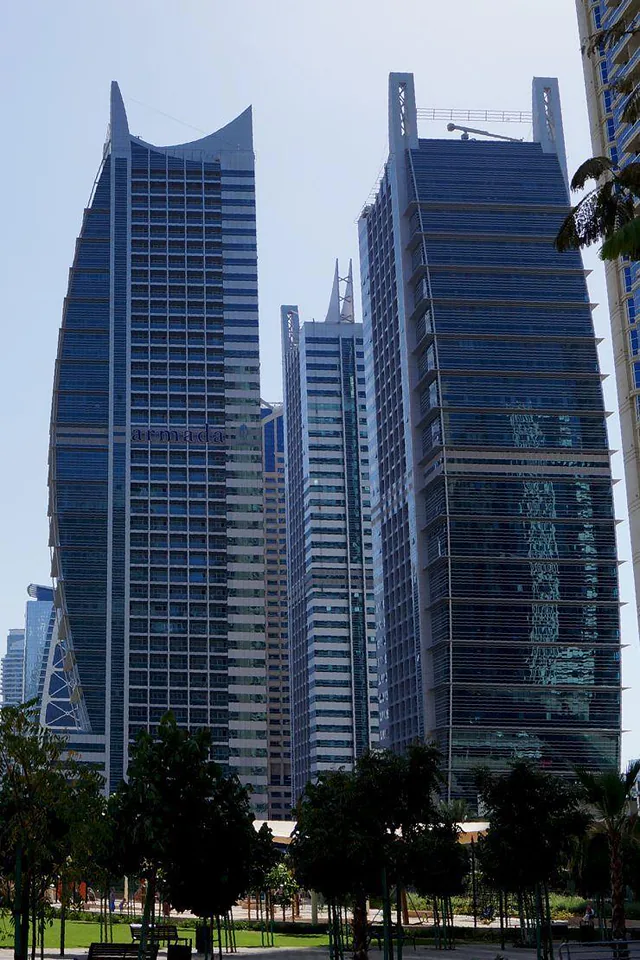
Armada Tower hotel, JLT
Jumeirah Lakes Towers (JLT) · MEP · Completed
MEP for the hotel tower of the three-building Armada Towers cluster.
G+14 building, Dubailand
Dubailand · HVAC · Completed
HVAC for a 14-storey residential building.
Frequently asked questions
Which authorities approve district cooling connection in Jumeirah Lakes Towers (JLT)?
Approvals in Jumeirah Lakes Towers (JLT) typically involve DMCC Authority, Dubai Civil Defence, Dubai Electricity & Water Authority and Al Sa'fat — Dubai Green Building Evaluation System. Exact routes depend on the plot, the master developer and whether the site sits in a free zone, so we confirm the authority matrix during mobilisation and prepare submissions accordingly.
Is district cooling available in Jumeirah Lakes Towers (JLT)?
District cooling is common in Jumeirah Lakes Towers (JLT), with Empower among the providers. Connection terms, energy-transfer-station design and capacity are agreed per plot with the provider, so the HVAC design should confirm availability before choosing between a connection and a dedicated chiller plant.
Can an existing building switch from chillers to district cooling?
It is possible where a provider serves the area and has capacity. The work typically involves building an ETS, reusing internal pipework after cleaning, and removing old chillers. Coils may need reviewing if provider temperatures differ from the original design. A condition survey of existing pipes is the first step.