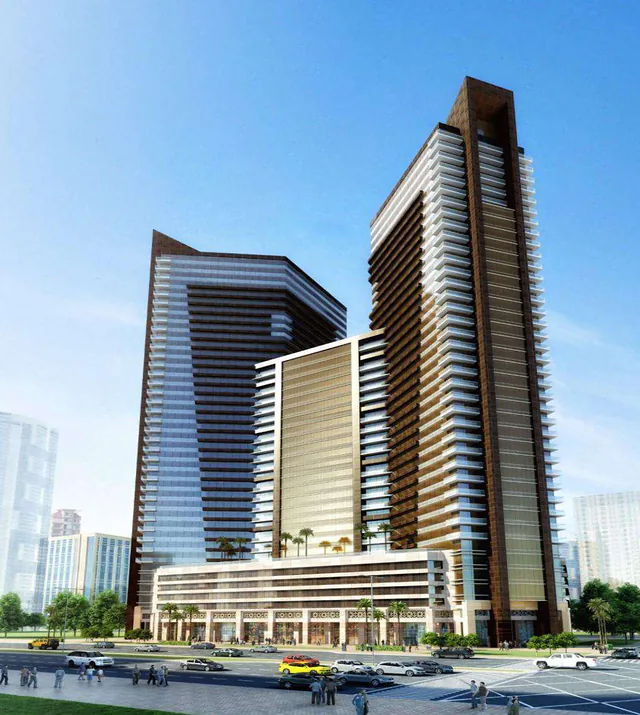
Building contracting in Jumeirah Village Circle (JVC): local context
Jumeirah Village Circle is a large community of mid-rise apartment buildings, townhouses and villas between Al Khail Road and Hessa Street, developed in phases since the late 2000s. It has become one of Dubai's busiest areas for mid-market residential construction, with many G+4 to G+20 buildings on individual plots. Construction is still active, so new builds sit next to occupied buildings and narrow internal roads.
- Typical plots have shallow podiums and compact plant rooms, so space for chillers, packaged units, water tanks and fire pumps must be fixed early in coordination with structure.
- Approvals can involve the master developer and Trakhees or Dubai Municipality depending on the plot, with Civil Defence review of fire systems; the route is confirmed per plot.
- Air-cooled chillers or VRF systems on rooftops face high roof temperatures, so selections are derated for summer conditions and placed with enough clearance to avoid hot-air recirculation.
Building types we serve in Jumeirah Village Circle (JVC)
For malls and retail centres, the work concentrates on large-volume air handling, tenant-ready chilled water or refrigerant capacity, smoke extraction for atriums and car parks and food-court exhaust.
Approvals and authorities in Jumeirah Village Circle (JVC)
Building contracting in Jumeirah Village Circle (JVC) sits within Dubai's regulatory framework. The authorities you will meet are:
- Dubai Municipality (DM)
- Trakhees (PCFC) (Trakhees)
- Dubai Civil Defence (DCD)
- Dubai Electricity & Water Authority (DEWA)
- Al Sa'fat — Dubai Green Building Evaluation System (Al Sa'fat)
- UAE Fire & Life Safety Code of Practice (UAE FLSC)
Scope of work
- Reinforced concrete frame including columns, cores, slabs and transfer structures, with pour sequences and curing planned for UAE temperatures.
- Building envelope packages including curtain wall or window systems, cladding, shading elements and sealants, coordinated with specialist subcontractors.
- Finishes, joinery, external works and landscaping interfaces, with MEP installed and commissioned in sequence by the group's MEP companies.
- Authority inspections, snagging, completion certificates and handover documentation, including keys, warranties and training for the client or operator.
Systems we install
- Basement waterproofing with membranes, waterstops and protection boards.
- Complete MEP: HVAC, electrical, plumbing, drainage, fire protection and BMS.
UAE site and climate challenges
- Basements in coastal Dubai and Sharjah often sit near or below groundwater with saline content that attacks reinforcement. Dewatering is planned with permits, membranes and waterstops are inspected before backfilling, and concrete cover is checked against the design.
- Sand and wind carry dust into fresh plaster, paint and MEP equipment. We sequence wet trades and finishing so building envelope closure comes first, and protect installed equipment until handover.
- Conventional formwork versus system formwork for repetitive floors: system formwork shortens tower floor cycles and improves finish quality, but needs upfront investment, crane capacity and an early structural design freeze.
Relevant Manolia projects
2B+G+15 residential tower, IMPZ
Dubai Production City (formerly IMPZ) · MEP · Completed
Full MEP package for a two-basement residential tower with gym.
2B+G+11 building, Al Nahda Dubai
Al Nahda (Dubai) · MEP · Completed
Complete MEP works for a residential building with basements and gym.
Frequently asked questions
Which authorities approve building contracting in Jumeirah Village Circle (JVC)?
Approvals in Jumeirah Village Circle (JVC) typically involve Dubai Municipality, Trakhees (PCFC), Dubai Civil Defence and Dubai Electricity & Water Authority. Exact routes depend on the plot, the master developer and whether the site sits in a free zone, so we confirm the authority matrix during mobilisation and prepare submissions accordingly.
How is quality controlled on site?
We work under a QMS structured to ISO 9001 requirements, with document control, supplier evaluation, inspection and test plans, daily site reports, internal audits and corrective actions. Inspections are recorded and closed before work is covered up or handed over.