Renovation and retrofit MEP in Al Majaz: local context
Al Majaz surrounds Khalid Lagoon and Al Majaz Waterfront in central Sharjah, a district of high-rise residential towers, hotels, offices and retail that grew mostly from the 1990s to 2010s. Its lagoon-front towers are some of the city's most recognisable, and many are now in their second cycle of MEP upgrades. Streets are busy and plots are tightly packed.
- Refurbishment of occupied towers involves replacing chillers, pumps and risers floor by floor, with coordinated shutdowns agreed with building management and SEWA where supplies are affected.
- Sharjah Civil Defence typically requires fire alarm, firefighting and emergency lighting upgrades to meet the current UAE Fire & Life Safety Code during major refurbishments.
- Limited street parking and loading space mean materials arrive in small loads and are moved by hoist or service lift during agreed hours.
Building types we serve in Al Majaz
For office buildings, the work concentrates on VAV or FCU zoning for flexible floor plates, tenant fit-out interfaces, energy metering and BMS integration.
Approvals and authorities in Al Majaz
MEP renovation in Al Majaz sits within Sharjah's regulatory framework. The authorities you will meet are:
- Sharjah Municipality (SM)
- Sharjah Civil Defence (SCD)
- Sharjah Electricity, Water & Gas Authority (SEWA)
- UAE Fire & Life Safety Code of Practice (UAE FLSC)
Scope of work
- Capacity checks on existing chilled water, electrical supply and water storage to confirm whether new tenants, kitchens or extra floors can be served without upgrades.
- Modification of fire alarm, sprinklers and smoke control to suit new partitions and ceilings, with drawings submitted for Civil Defence approval where layouts change.
- Coordination with building management for permits to work, isolations, noise windows, lift use and protection of common areas during the works.
- Testing, commissioning and as-built documentation of all new and modified systems, including re-balancing of the existing systems affected by the changes.
Systems we install
- Replacement air-cooled or water-cooled chillers and their pumps.
- Replacement water and drainage pipework and new wet areas for fit-outs.
UAE site and climate challenges
- Replacing cooling equipment during summer risks leaving occupants without AC when temperatures exceed 45°C. We schedule major plant changes for cooler months where possible, or install temporary chillers or packaged units to maintain cooling during the changeover.
- Older UAE buildings often have undersized or poorly dehumidified fresh-air systems, causing mould, musty smells and sweating grilles. Retrofits add dedicated fresh-air units with proper dehumidification instead of simply enlarging fan coils.
- Repair versus replace: the choice depends on equipment age, efficiency, refrigerant type, parts availability and how long the owner plans to keep the building, supported by survey data rather than assumptions.
Relevant Manolia projects
Apartment-hotel building, Al Nahda Sharjah
Al Nahda (Sharjah) · MEP · Completed
MEP for a combined residential and hotel building with health club.
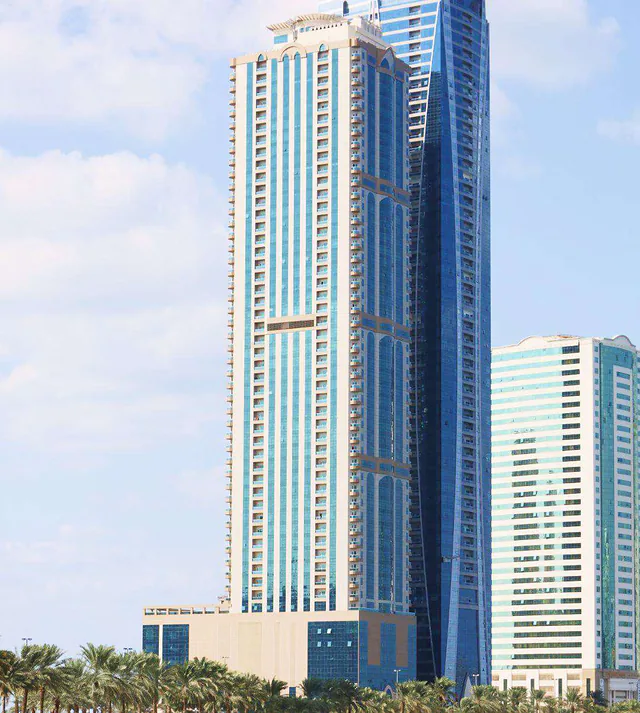
Al Salam Tower, Sharjah
Sharjah · HVAC · Completed
Chiller plant and roof chilled-water network for a 52-typical-floor tower.
Frequently asked questions
Which authorities approve MEP renovation in Al Majaz?
Approvals in Al Majaz typically involve Sharjah Municipality, Sharjah Civil Defence, Sharjah Electricity, Water & Gas Authority and UAE Fire & Life Safety Code of Practice. Exact routes depend on the plot, the master developer and whether the site sits in a free zone, so we confirm the authority matrix during mobilisation and prepare submissions accordingly.
Does Manolia work in Al Majaz?
Yes. Al Majaz is in Sharjah, roughly 20–60 minutes from central Dubai depending on traffic. Site teams are mobilised from our Dubai headquarters with supervision, QA/QC and HSE staff assigned to each project.
Can existing chillers support new loads?
Only if genuine spare capacity exists at peak summer conditions, not just on paper. We review nameplate data, operating logs and measured temperatures, and check pumps and pipework too. If capacity is insufficient, options include plant upgrades, separate units or reducing loads elsewhere.