Building contracting in Sharjah Industrial Area: local context
Sharjah's industrial areas, numbered from Industrial Area 1 to 18 between the city and the Dubai border, form one of the UAE's largest concentrations of workshops, factories, warehouses and staff accommodation. Much of the stock is older steel-frame and block construction from the 1980s–2000s. Work here mixes new industrial buildings with upgrades to existing ones. The areas border Al Qusais in Dubai, making them easy to reach from Manolia's base.
- Factories and workshops need heavy electrical supplies, motor control centres and process ventilation, coordinated with SEWA for load approval and metering.
- Older buildings frequently need fire protection upgrades to satisfy Sharjah Civil Defence during change of use or renewal.
- Dust and heat are severe, so ventilation and cooling equipment must be robust and accessible for cleaning.
Building types we serve in Sharjah Industrial Area
For warehouses and logistics buildings, the work concentrates on high-bay sprinklers or in-rack protection, smoke venting, dock and office HVAC, and LV for racking, lighting and material handling.
Approvals and authorities in Sharjah Industrial Area
Building contracting in Sharjah Industrial Area sits within Sharjah's regulatory framework. The authorities you will meet are:
- Sharjah Municipality (SM)
- Sharjah Civil Defence (SCD)
- Sharjah Electricity, Water & Gas Authority (SEWA)
- UAE Fire & Life Safety Code of Practice (UAE FLSC)
Scope of work
- Site mobilisation, hoarding, temporary power and water, site offices and HSE set-up under our HSEMS, with logistics planned around crane positions, deliveries and neighbouring plots.
- Excavation, dewatering where groundwater requires it, shoring and foundations, including raft or piled foundations as designed by the structural engineer.
- Finishes, joinery, external works and landscaping interfaces, with MEP installed and commissioned in sequence by the group's MEP companies.
- Authority inspections, snagging, completion certificates and handover documentation, including keys, warranties and training for the client or operator.
Systems we install
- Reinforced concrete frames with post-tensioned or conventional slabs as designed.
- Complete MEP: HVAC, electrical, plumbing, drainage, fire protection and BMS.
UAE site and climate challenges
- Basements in coastal Dubai and Sharjah often sit near or below groundwater with saline content that attacks reinforcement. Dewatering is planned with permits, membranes and waterstops are inspected before backfilling, and concrete cover is checked against the design.
- Sand and wind carry dust into fresh plaster, paint and MEP equipment. We sequence wet trades and finishing so building envelope closure comes first, and protect installed equipment until handover.
- Facade system choice: unitised curtain wall installs faster with factory quality control, while stick systems are more flexible for complex geometry, smaller buildings and late design changes.
Relevant Manolia projects
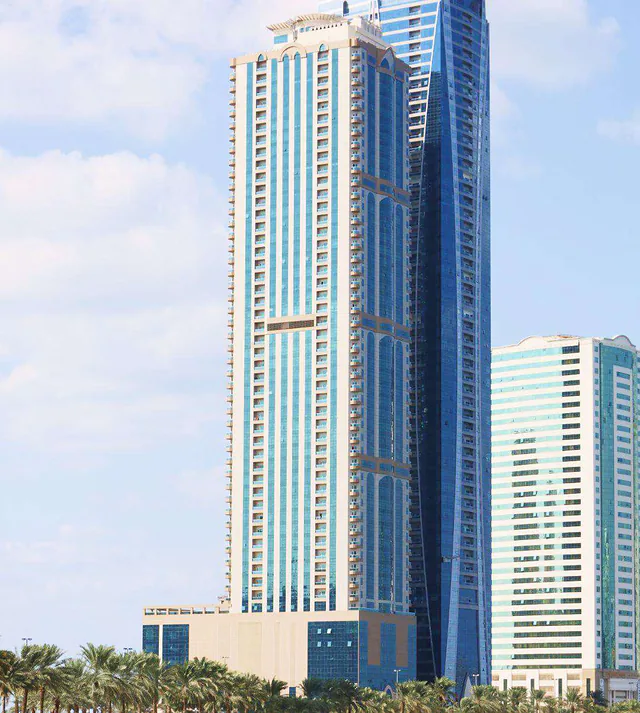
Al Salam Tower, Sharjah
Sharjah · HVAC · Completed
Chiller plant and roof chilled-water network for a 52-typical-floor tower.
G+29 residential tower, Sharjah
Sharjah · MEP · Completed
Full MEP package for a 29-storey tower.
Frequently asked questions
Which authorities approve building contracting in Sharjah Industrial Area?
Approvals in Sharjah Industrial Area typically involve Sharjah Municipality, Sharjah Civil Defence, Sharjah Electricity, Water & Gas Authority and UAE Fire & Life Safety Code of Practice. Exact routes depend on the plot, the master developer and whether the site sits in a free zone, so we confirm the authority matrix during mobilisation and prepare submissions accordingly.
Does Manolia work in Sharjah Industrial Area?
Yes. Sharjah Industrial Area is in Sharjah, roughly 20–60 minutes from central Dubai depending on traffic. Site teams are mobilised from our Dubai headquarters with supervision, QA/QC and HSE staff assigned to each project.
What does a main building contractor do?
A main contractor takes responsibility for constructing the whole building to the approved drawings: structure, envelope, finishes and services, either directly or through subcontractors. The main contractor manages programme, site safety, quality, inspections and coordination, and hands over a completed building with documentation.